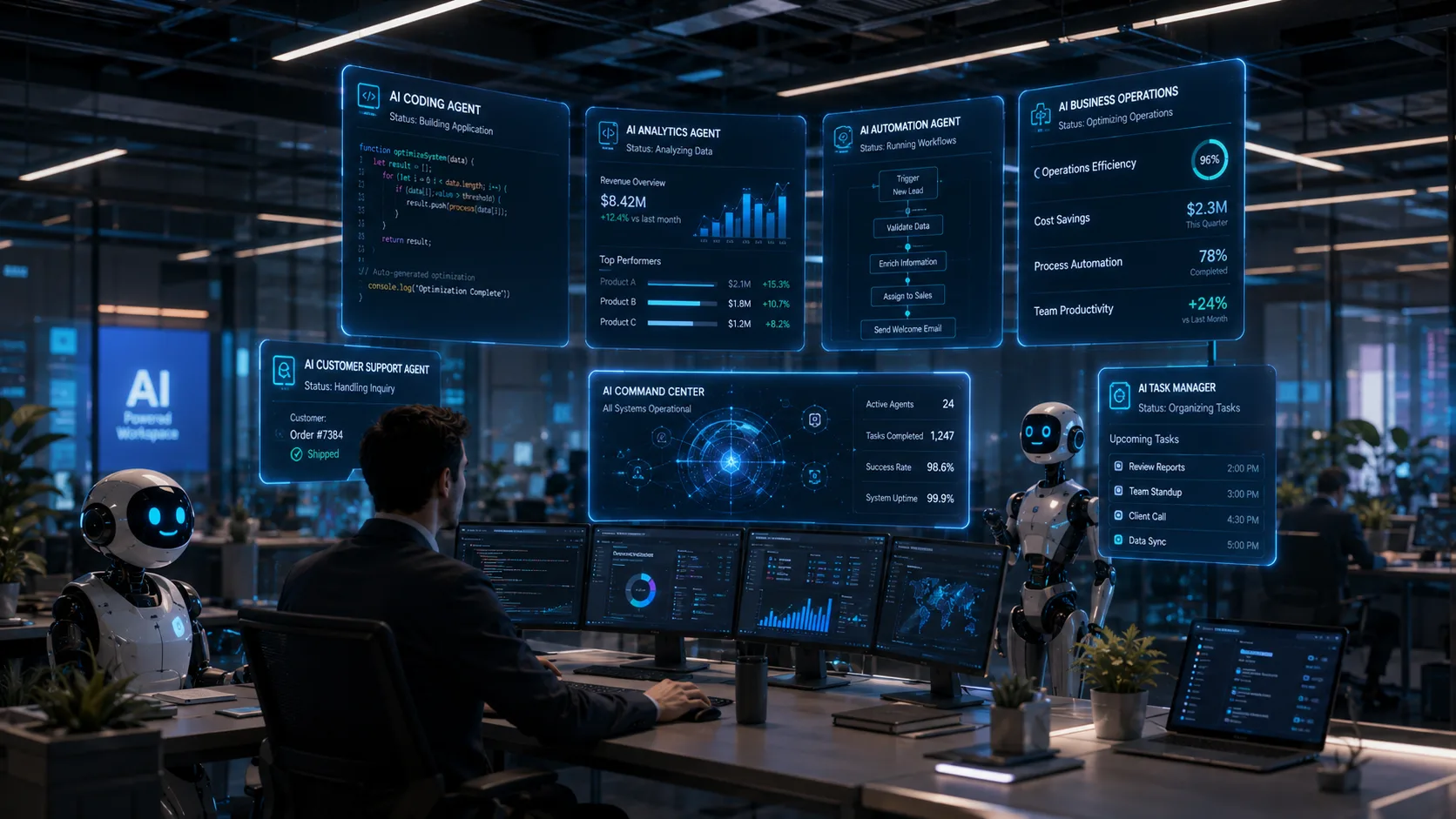
The AI Agent Boom in 2026: Why Autonomous AI Is Becoming the Next Big Tech Shift
IntroductionFor the last few years, AI has mostly been about chatbots.You ask a question.AI gives an answer.But in 2026, something much bigger is happening.AI is starting to move b
Introduction
For the last few years, AI has mostly been about chatbots.
You ask a question.
AI gives an answer.
But in 2026, something much bigger is happening.
AI is starting to move beyond conversations and into action.
This new wave is called AI agents — autonomous systems capable of planning tasks, using tools, making decisions, and executing workflows with minimal human input.
And honestly?
This may become one of the biggest technology shifts since the smartphone era.
What Exactly Are AI Agents?
Traditional AI tools respond to prompts.
AI agents go much further.
They can:
- Break goals into tasks
- Use external tools
- Search information
- Analyze data
- Automate workflows
- Execute multi-step actions
Instead of acting like assistants, they behave more like digital workers.
This shift toward “agentic AI” is becoming one of the defining AI trends of 2026. :contentReference[oaicite:0]{index=0}
Why Everyone Suddenly Cares About AI Agents
The reason is simple:
Companies are overwhelmed by workflows.
Employees constantly switch between:
- Emails
- Dashboards
- Meetings
- Spreadsheets
- Documentation
- Support systems
AI agents are being designed to reduce that operational chaos.
Instead of automating one small task, AI agents can coordinate entire workflows across multiple systems. :contentReference[oaicite:1]{index=1}
That’s a massive difference.
Big Tech Is Racing Into Agentic AI
Almost every major AI company is now investing heavily in autonomous AI systems.
Google has publicly focused on “agentic workflows” and predicts AI agents will become deeply integrated into productivity and enterprise systems. :contentReference[oaicite:2]{index=2}
Meta is reportedly developing advanced AI assistants capable of handling personalized tasks more autonomously. :contentReference[oaicite:3]{index=3}
Meanwhile, startups are building entire businesses around AI agents for:
- Coding
- Customer support
- Marketing
- Research
- Operations
The competition is accelerating incredibly fast.
AI Coding Agents Are Already Changing Software Development
One of the biggest transformations is happening in software engineering.
Modern AI coding agents can:
- Write code
- Debug issues
- Refactor projects
- Generate documentation
- Run tests
Some major tech companies now report that large portions of their new code are AI-generated and then reviewed by engineers. :contentReference[oaicite:4]{index=4}
This doesn’t mean developers disappear.
It means developers increasingly manage and supervise AI-driven workflows instead of manually writing every repetitive task themselves.
The Rise of Autonomous Workflows
The future of AI is not just smarter chatbots.
It’s autonomous execution.
AI agents are now being integrated into:
- CRM systems
- Marketing automation
- Security monitoring
- Business analytics
- Workflow orchestration
Many businesses are moving from simple automation toward fully agent-driven systems capable of operating continuously in the background. :contentReference[oaicite:5]{index=5}
This is changing how modern companies think about productivity.

But There’s Also a Serious Debate
Not everyone is completely optimistic.
AI agents introduce major questions around:
- Security
- Reliability
- Governance
- Oversight
- Accountability
Researchers warn that autonomous systems still face challenges with reasoning accuracy, long-term planning, and safety controls. :contentReference[oaicite:6]{index=6}
As AI becomes more autonomous, companies will likely need stronger guardrails and monitoring systems.
Why This Trend Matters More Than Previous AI Waves
Previous AI trends focused on content generation.
This one focuses on execution.
That changes the economics of work itself.
AI agents are no longer just helping people brainstorm ideas.
They are increasingly helping companies:
- Reduce operational costs
- Speed up workflows
- Improve productivity
- Scale faster
According to industry reports, operational efficiency and employee productivity remain among the biggest reasons businesses are adopting AI systems aggressively. :contentReference[oaicite:7]{index=7}
What Happens Next?
Over the next few years, we will likely see:
- AI-native companies
- Autonomous digital employees
- AI-managed workflows
- Multi-agent collaboration systems
- Industry-specific AI operations
The transition has already started.
And honestly, most people still underestimate how quickly this shift is happening.
Final Thoughts
The AI industry is entering a completely different phase.
The focus is no longer just generating text or images.
It’s about getting real work done.
AI agents are turning artificial intelligence from a passive tool into an active system capable of planning, coordinating, and executing tasks autonomously.
And in 2026, this may become the single biggest trend shaping the future of technology and work.
Frequently Asked Questions
What is an AI agent?
An AI agent is an autonomous AI system capable of planning tasks, using tools, and executing workflows with minimal human input.
How are AI agents different from chatbots?
Chatbots mainly respond to prompts, while AI agents can take actions, automate workflows, and complete multi-step tasks independently.
Why are AI agents becoming popular?
Businesses want to reduce repetitive work, improve productivity, and automate complex operational processes.
Which industries are using AI agents?
AI agents are increasingly being used in:
- Software development
- Customer support
- Marketing
- Business automation
- Cybersecurity
- Analytics
Will AI agents replace human jobs?
Most experts believe AI agents will transform workflows rather than completely replace humans, creating new AI-related roles alongside automation.